
17 Years of Indian Accent Delhi: The Anniversary Menu That Proves Modern Indian Cooking Is Still Evolving

Updated: Aug 19
Seventeen years is a long time in any industry. In the restaurant world, it is practically a miracle. Indian Accent in New Delhi has not just survived those seventeen years — it has spent them quietly, persistently rewriting what Indian food can be on a fine dining plate. The restaurant now has a decade-old presence in New York and a three-year-old table in Mumbai, making it one of the few modern Indian restaurants that has genuinely travelled and landed well. The anniversary occasion brings with it a refreshed tasting menu at The Lodhi. We went for lunch and did the four-course non-vegetarian Lite Tasting Menu, though the kitchen, generous as ever, made sure we left having tasted rather more than four courses.
Reflecting on the milestone, Chef Shantanu Mehrotra shared, “As Indian Accent enters its 17th year, I also mark 27 years with the company, a journey that began when I joined as a trainee. The menu draws inspiration from the season while also bringing back a few favourites that have been loved by our guests over the years.”
The Room Before The Food At Indian Accent
There is something about the way Indian Accent is lit that puts you at ease before a single plate arrives. It is warm without being dim, quiet without being stiff. The dining room at The Manor has always had the feeling of someone's very well-appointed home, and on an anniversary evening that quality feels especially apt. If you are going for dinner, it is worth knowing that Upstairs at Indian Accent — the intimate cocktail bar that operates by invitation for diners — opens at six in the evening. Coming in for a cocktail and some live music before your seating is not a bad way to begin a long night.
The kitchen is now led by Executive Chef Shantanu Mehrotra and Head Chef Hitesh Lohat, who between them have been part of this operation long enough to understand its character deeply. There is a confidence to the cooking here that does not feel like arrogance. It feels like the kind of ease that comes from having done something correctly for a very long time.
First Course: Smoked Duck And Thai Pomelo Salad, Honey Kasundi Glaze

This is a sharp, clever way to begin. Pomelo has that wider, more bitter citrus quality that grapefruit cannot quite replicate, and the smoked duck alongside it is not the obvious choice — which is exactly why it works. The smoking adds a layer of savouriness that makes the honey kasundi glaze land somewhere more interesting than sweetness alone. Kasundi, for the uninitiated, is a Bengali fermented mustard condiment with real depth and a certain sharpness. The honey rounds it just enough without dimming it.
What strikes you about this opening course is how light it feels while carrying real flavour. There is acidity, a little smoke, some sweetness, some mustard heat, and the bright bitterness of the pomelo cutting through all of it. It reads as a salad but functions as a proper statement of intent — the kitchen is going to be making interesting decisions, and the decisions are going to be well-considered.
Second Course: Kolhapuri Chicken, Masala Oat Roti, Avocado

Kolhapuri spice has a reputation for directness. It is not subtle; it has heat and depth and a certain confidence built on a blend of dried chillies and coconut that gives it a character quite unlike the north Indian spice palette most people encounter more often. The chicken here carries that spice properly — this is not a polite gesture towards Kolhapuri flavour.
The avocado is the move that could easily feel like a stunt. It does not. The fat of a good avocado absorbs and softens chilli heat without muffling it, and that is precisely what happens here. The masala oat roti is where your attention keeps returning, though. Oats bring a nuttiness, a slight chewiness, and a texture that wheat flour alone does not produce. It is a small intervention but a meaningful one, and it keeps the bread from being an afterthought. The course has warmth and generosity without heaviness, which matters at this point in the meal.
The Sorbet: Intermission
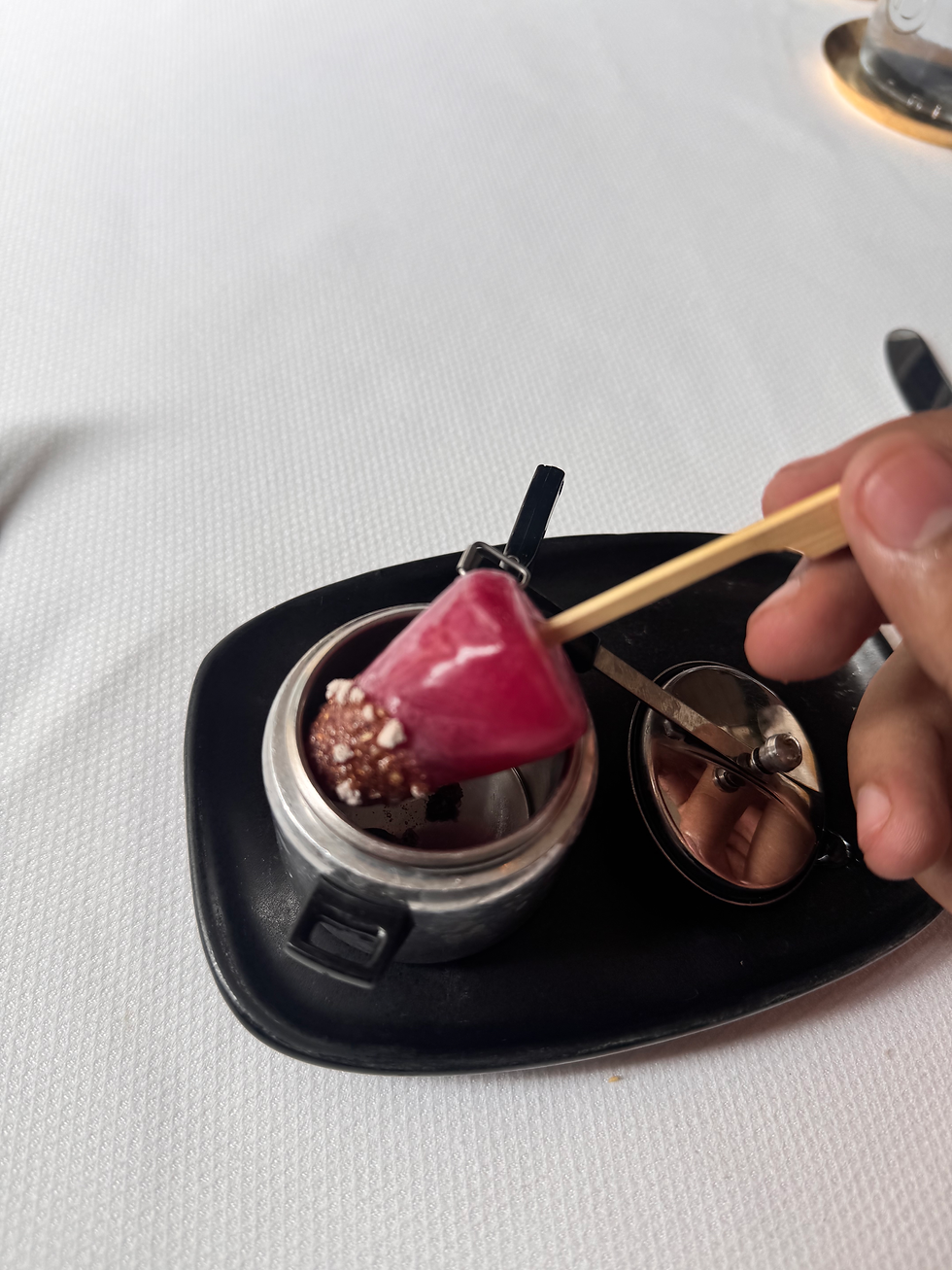
Between the second and third courses comes the Indian Accent sorbet, and its function is exactly what it sounds like — a pause. After two courses of layered, complex flavour, you need a moment to reset, and the kitchen gives you one. This is not an afterthought. A meal without a mid-point breath can feel relentless. The sorbet does the quiet structural work of making sure the main course arrives with your palate genuinely ready.
Third Course: Seared John Dory, Kerala Moilee, Asparagus

John Dory is a delicate fish, and it can be overwhelmed with very little effort. The kitchen does not overwhelm it. The moilee — a light coconut milk curry from Kerala, fragrant with green chillies and turmeric and tempered with mustard seeds — is exactly calibrated for this fish. It is aromatic without being aggressive, creamy without being heavy. The John Dory sits in it rather than beneath it, and the asparagus gives you the structural contrast that a dish this gentle genuinely needs.
This is the most classically composed course on the menu, and in some ways the most impressive precisely because of that. There is nowhere to hide when the fish is this delicate and the sauce this restrained. The sear on the fish is clean, the flesh holds together, and the moilee is the kind of preparation that makes you think about Kerala in the best possible way. It is comfort food elevated to the point where you stop noticing the elevation and simply enjoy the comfort.
The Accompaniments: Dal Sultani, Jakhiya And Mint Boondi Raita, Herb Millet Roti

These arrive alongside the main course and anchor the meal in a way the lighter, more inventive courses build towards. The dal sultani is a slow-cooked, rich lentil preparation, and it is deeply satisfying in the way that only patient cooking produces. It is the kind of dal you want a second helping of. The herb millet roti continues the kitchen's habit of substituting grains thoughtfully — lighter and slightly grassy, and genuinely good with the dal.
The boondi raita with jakhiya is the quietly memorable thing on this table. Jakhiya is a wild seed from Uttarakhand, related to the same family as mustard and with a similarly sharp, earthy quality when tempered in hot oil. It gives the raita a dimension that plain cumin simply would not. It is cooling and complex at once, and it is the kind of detail that tells you this kitchen is not coasting on its reputation.
The Kulchas: Butter Chicken Kulcha, Duck Hoisin Kulcha
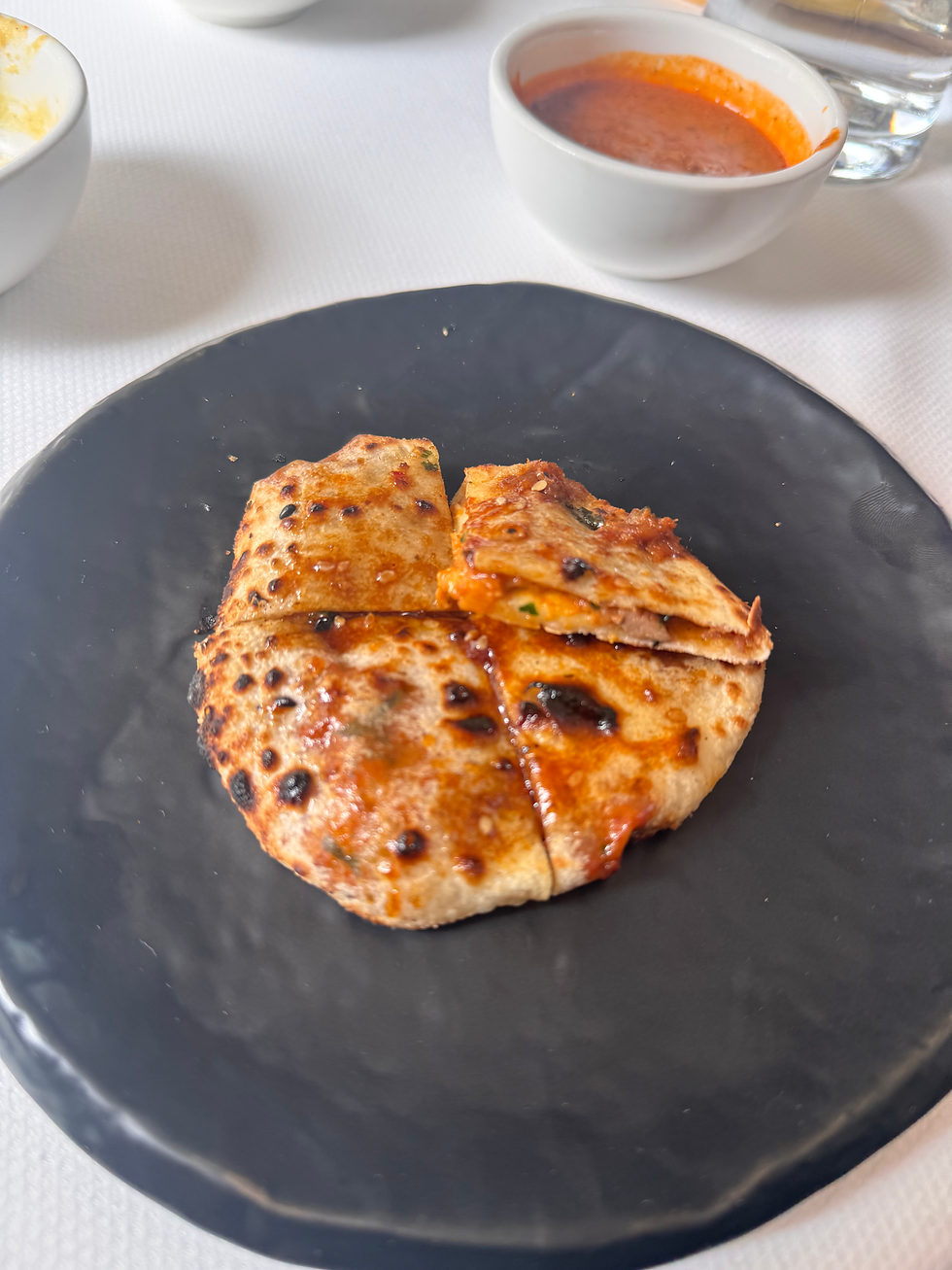
The bread bar is one of Indian Accent's long-standing signatures, and on this visit the kitchen brought out both the butter chicken kulcha and the duck hoisin kulcha. They arrived warm, palm-sized, stuffed, and they deserve their own moment.
The butter chicken kulcha is arguably the dish that made the bread bar famous. The filling is exactly what it sounds like — real, properly made butter chicken, rich and tomato-forward and gently spiced, enclosed in a soft, lightly charred kulcha. The ratio of bread to filling is right. You get enough of the gravy to understand what you are eating without the whole thing becoming unwieldy. It is nostalgic and precise at the same time, which is a combination this kitchen understands better than most.
The duck hoisin kulcha is the more adventurous of the two. Duck cooked down into a soft filling with the umami sweetness of hoisin, inside a kulcha that takes the richness without buckling — it is the kind of East-meets-subcontinent move that reads as obvious only in retrospect. Regulars have long called the duck hoisin kulcha a highlight of the bread bar, and having had it, that reputation is entirely understandable. Both kulchas together make a strong case for the argument that Indian Accent's breads are as considered as any other course on the menu. They are not a side. They are a destination.
Dessert: Kinnaur Apple, Nut Crumble And Jaggery — And Then Some

The Lite Menu's own dessert, the kinnaur apple with nut crumble and jaggery, is the most restrained of the evening's sweet courses. Kinnaur apples, grown in Himachal Pradesh's high-altitude orchards, have a tartness that the common apple cannot match, and the jaggery brings an unrefined, slightly smoky sweetness that feels entirely appropriate at the end of a meal this thoughtfully Indian. The nut crumble adds texture. It is not a showy dessert. It is a considered one.

From the Chef's Tasting Menu, the kitchen then brought out the motichoor ladoo — and this is where expectations need to be recalibrated before it arrives, because it bears little resemblance to the gram flour sweet you know from every mithai shop you have ever visited. The outer boondi shell is there, familiar and golden, but inside sits a cream cheese filling encased in a white chocolate shell. It is a genuinely clever piece of cooking. The cream cheese brings a slight tang that cuts through the sweetness of the boondi, and the white chocolate acts as a bridge between the two rather than adding more sugar to an already sweet thing. It looks like a ladoo. It surprises you like almost nothing else on the menu.
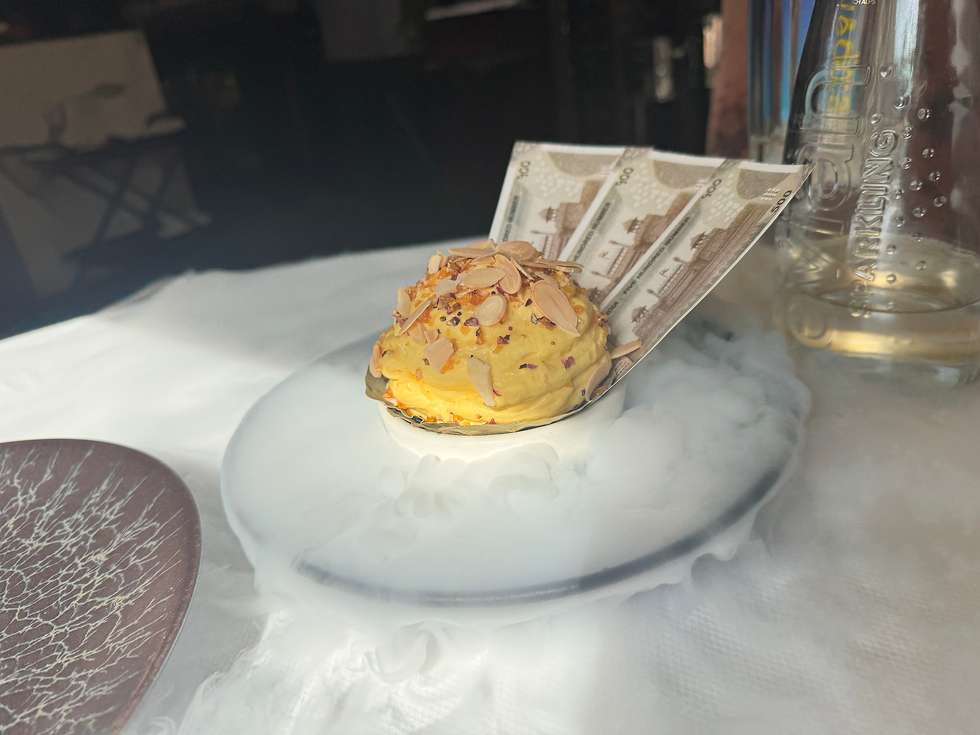
Then came the daulat ki chaat, and if the motichoor ladoo is a surprise, this is something closer to an experience. Indian Accent uses nitrogen capsules to cool the milk before whisking the foam, finishing it with nuts and candied rose petals, and serving it in a terracotta pot exuding cold smoke. Daulat ki chaat in its street form is a Chandni Chowk winter delicacy — milk churned for hours until it produces an impossibly light, barely-there froth that dissolves the moment it reaches your tongue. The kitchen's version honours that essential quality, that weightlessness, while adding enough theatre and refinement to make it feel at home in this dining room. It is the most Delhi thing on the menu and one of the best things we ate all evening.

The single origin Manam chocolate cake with basundi and berries brought the lunch to a close. Manam is one of India's most serious bean-to-bar chocolate makers, and using their chocolate here is a sourcing decision that shows up in the flavour — the cake has the kind of depth that mass-market chocolate simply cannot produce. The basundi, reduced and sweetened and aromatic, is the right Indian counterpart for it. The berries cut through the richness cleanly. It is a confident conclusion, and it lingers.
17 Years Of Excellence, Indian Accent
Seventeen years in, and the kitchen is still asking interesting questions. The four-course Lite Tasting Menu at Rs 4,000 per person is the most accessible way into what Indian Accent is doing right now — shorter, lighter, and more forgiving of a weeknight appetite — but it carries the same creative intelligence as the fuller Chef's Tasting. Add the kulchas, because they are the bread bar at its most characterful. Stay for every dessert course you are offered, because the motichoor ladoo and the daulat ki chaat alone justify the evening. The meal we had was the kind that makes you grateful for restaurants that have been around long enough to know exactly what they are doing. Indian Accent, seventeen years in, knows.


Comments