
World Tiramisu Day: The Dessert That Started In A Brothel And Ended Up At The Oscars

Every year on the 21st of March, the world celebrates World Tiramisu Day, a fact that feels both entirely appropriate and slightly absurd for a dessert that is, at its most basic, a refrigerated coffee cake. But then again, tiramisu has never been just a dessert. It is a cultural object, a contested identity, a platform for the most heated arguments in Italian gastronomy, and the subject of a genuine competitive world cup held annually in the very city where it was born. From a brothel in 19th-century Treviso to a dessert counter in Chennai, this pick-me-up has picked up the entire world along the way, and the story of how that happened is considerably more interesting than the ingredient list suggests.
What Tiramisu Is, And What The Name Actually Means

Start with the name, because it tells you a lot. Tiramisu comes from the Treviso dialect phrase "tireme su," which translates literally as "pull me up" or "pick me up." The name is a direct reference to the energising combination at the dessert's core: coffee and sugar and egg, all substances that the human body responds to with enthusiasm. Every spoonful is, in theory, a small lift, which makes tiramisu one of the few desserts in the world whose name is a promise rather than a description.
The dessert itself is a layered preparation of savoiardi biscuits (the long, dry, sponge-like biscuits called ladyfingers in English) soaked in cold espresso, alternating with a cream made from egg yolks beaten with sugar and folded into mascarpone cheese, finished with a generous dusting of bitter cocoa powder. No baking required. No complicated techniques. Just assembly, patience, and several hours in the refrigerator while the layers set and the flavours deepen into something that tastes like considerably more than the sum of its parts.
The Contested Origin: Brothels, Courts, And A Restaurant In Treviso

The origin story of tiramisu is one of the great food arguments of the 20th century, and it has generated more heat than a professional oven.
The most widely accepted account traces the modern tiramisu to the restaurant Alle Beccherie in Treviso in the early 1970s, where chef Roberto "Loli" Linguanotto and owner Ado Campeol developed the recipe together. Campeol spent years asserting this claim, and the restaurant in Treviso still carries the legacy of being tiramisu's birthplace. Massimo Linguanotto, Roberto's son, still serves on the jury of the annual Tiramisu World Cup held in the city.
But there is a far older, more colourful backstory. In its most elemental prehistoric form, tiramisu was something called lo sbatudin in the Veneto dialect, a preparation of raw egg yolks beaten with sugar until pale and frothy, eaten plain or used to dip biscuits. This preparation existed in Veneto farmhouses and kitchens for centuries before mascarpone and espresso entered the picture. It was caloric, energising, and cheap to make, which is why a version of it, spiked with Marsala wine and served with savoiardi, is said to have been offered to clients in the brothels of northern Italy in the 1800s as a restorative. Whether this is documented history or a well-circulated food myth, it has given tiramisu a past that is simultaneously scandalous and entirely consistent with the name. A pick-me-up, served in the places that most needed one.
What a clever pastry chef eventually did was bring all the elements together into the layered, chilled format we now know. The Beccherie version crystallised this into a recipe, and from Treviso it moved quickly. By the 1980s it was on Italian restaurant menus across Europe and North America. By the 1990s it had become the default "sophisticated Italian dessert" on menus everywhere from London to Singapore. By the early 2000s, it had reached India and settled into the dessert menus of every Italian restaurant in every Indian metro, where it has remained ever since.
The Six Ingredients And The War Around Them
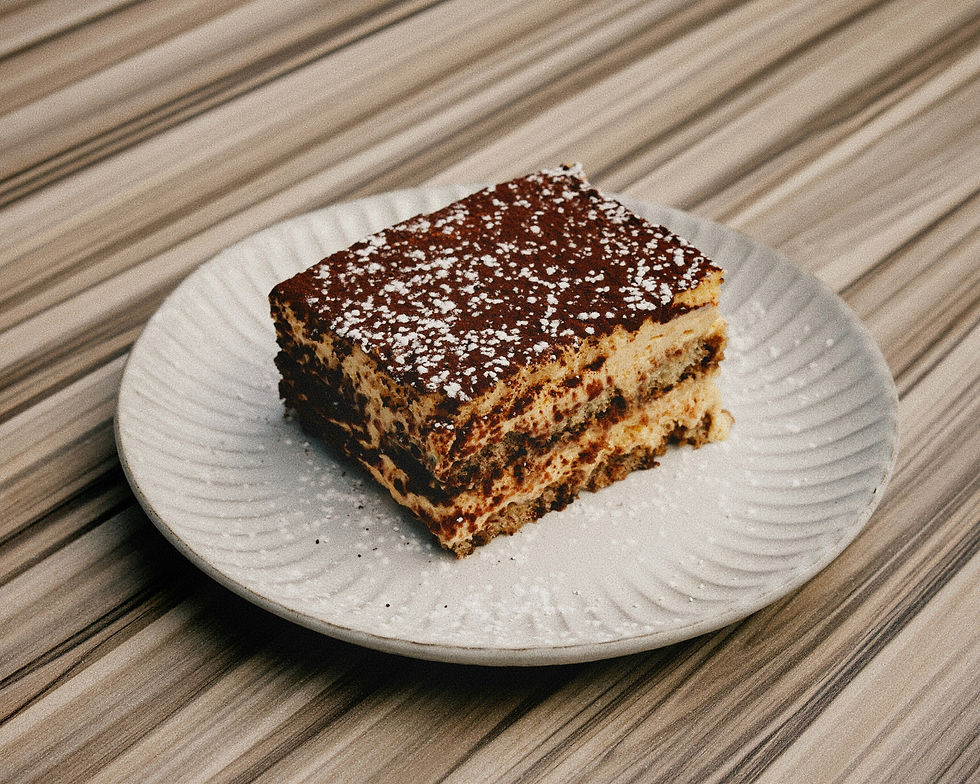
The Accademia del Tiramisù, based in Treviso, has codified the classic recipe to six ingredients: mascarpone, eggs, sugar, savoiardi, coffee, and bitter cocoa powder. This is the definitive formula. Nothing added, nothing substituted.
And yet, almost no one makes it exactly this way, and this is where the arguments begin.
The egg white question is the oldest. Some recipes include whipped egg whites folded into the cream for lightness. Others use only yolks, producing a denser, richer result. Both camps have committed advocates and no desire to compromise. The cream question is similarly unresolved: purists insist mascarpone alone is correct, while the majority of home and restaurant recipes add whipping cream for extra lightness and stability. The alcohol question gets heated at family gatherings: the Accademia's official recipe has no alcohol, but a large portion of the Italian tiramisu tradition includes Marsala wine, rum, or coffee liqueur in the espresso soak. The biscuit question is subtler but real: savoiardi are thicker and spongier, absorbing less liquid and producing a more compact result, while the thinner Pavesini biscuits give a softer, creamier texture throughout.
Each of these debates has adherents who speak with the conviction of people defending something genuinely important. In Treviso, where the dessert was born, the intensity of these arguments is a form of civic pride.
The Tiramisu World Cup: A Competition Worth Knowing About

Every October, the city of Treviso transforms itself for three days into the unlikely centre of the dessert world. The Tiramisu World Cup (TWC), launched in 2017, is a competition open exclusively to amateur home cooks from any country, built on the democratic premise that the best tiramisu in the world might be sitting in someone's home kitchen rather than a professional pastry lab.
The first edition attracted 720 competitors, with over 500 media outlets covering it, numbers that surprised everyone involved. The competition runs in two categories: Original Recipe (the classic six ingredients, strictly no additions) and Creative Recipe (mascarpone, eggs, coffee, and cocoa are compulsory; up to three additional ingredients permitted). Judges must pass a 15-question quiz on the rules before being admitted, and competition for judging spots is almost as fierce as competition for winning them. In 2025, the judging application closed in under 24 hours, with 350 spots filling almost immediately.
The winners are a genuinely varied group. In 2019, Sara Arrigoni won the Creative category with a non-alcoholic mojito tiramisu. In 2021, the theme was cinema, and competitors were asked to interpret the dessert through the lens of a film. The 2025 edition, the ninth, was won in the Original category by Barbara Tosato, a medical radiotherapy technician from Mestre near Venice. Daniela De Biasio, an agritourism worker from the Prosecco Hills, won Creative with her creation "Il Golosone," which incorporated salted caramel cream and apricot compote.
The organiser Francesco Redi has described the event's ambition in terms that make plain how seriously Treviso takes its ownership of the dessert: "Our task has been to project the image of this dessert so closely linked to Treviso to the world, as it is now a heritage of ours on par with the Eiffel Tower."
What the competition has also revealed, year after year, is the extraordinary range of what tiramisu can be. Roughly 75 per cent of competitors at any given edition are women. Entrants come from Japan, Brazil, India, the United States, and across Europe. The dessert that began in a single restaurant in a mid-sized Italian city now has a World Cup, and people are flying in from around the world to compete in it.
The Variations: How The Dessert Has Evolved

Outside the competition's strict categories, tiramisu has evolved into something that no single recipe can contain.
The most logical variations play with the soaking liquid. Limoncello tiramisu replaces espresso with a milk-and-lemon-liqueur mixture, producing a pale, fragrant, summer-appropriate result. Matcha tiramisu, enormously popular in Japan and increasingly appearing in Indian cafés, uses cold matcha in place of coffee for a green, vegetal bitterness against the sweet mascarpone. Strawberry tiramisu abandons coffee entirely in favour of fresh berry coulis, creating a lighter, fruit-forward dessert suited to people who want tiramisu without the caffeine.
More adventurous interpretations include a panettone tiramisu (the festive Italian bread standing in for savoiardi), a s'mores tiramisu, cherry tiramisu with kirsch, and what the food writer Jenny Arena has called “Nutellamisu”, a version built around hazelnut chocolate spread. Italian food writers Clara and Gigi Padovani, whose book on tiramisu documents dozens of variations by professional pastry chefs across Italy, treat this creative freedom as a sign of the dessert's cultural health rather than a threat to its integrity.
In India specifically, tiramisu has taken on a quietly local character. South Indian filter coffee decoction, with its particular bitterness and depth, turns out to work exceptionally well as the soaking liquid, arguably better than mediocre espresso. Cardamom-spiked mascarpone cream appears in Indian fusion bakeries and is a genuinely appealing variation. Mango tiramisu using Alphonso pulp layers during the April-to-June season has appeared on Mumbai and Pune menus and makes a kind of intuitive sense given how well mascarpone and ripe mango coexist.
Why Tiramisu Specifically Has Lasted

Many desserts have had their moment and receded. Tiramisu has not receded. It has been on menus for fifty years and shows no signs of leaving them. The Grub Street food writer Helen Rosner put it memorably: tiramisu is "just the right amount of things." Not too sweet, not too rich, not too light, not too bitter. The coffee gives it the quality of an adult decision. The mascarpone gives it indulgence. The cocoa gives it complexity. The savoiardi give it texture. Nothing is excessive.
It also travels exceptionally well as both a restaurant dessert and a home preparation, which is unusual. Most restaurant-quality desserts are either too technically demanding for home cooks or too simple to justify ordering when eating out. Tiramisu sits in neither category, it is satisfying to make at home and satisfying to order in a restaurant, and it tastes noticeably different depending on who is making it and what quality of ingredients they are using.
The Italian Love
Tiramisu's trajectory from a small restaurant in Treviso to a global cultural phenomenon has been driven by the same thing that drives any food that lasts: it is genuinely, repeatedly, reliably good. Not in a complicated or fussy way, but in the way of things that have been refined slowly over time until nothing unnecessary remains. World Tiramisu Day on the 21st of March is as good a reason as any to eat one, make one, or argue about whether cream should go in it. Treviso has been having that argument for decades. The rest of the world, it seems, has fully caught up.


Comments